
Digital vs Analog Wireless: The Evolution of Wireless Systems.
Driving or multitasking? Tune in to the audio version of this post.
The Brief
Wireless technology has revolutionised the professional audio market, enabling the delivery of clean, reliable sound without the physical limitations of cables. Within this field, two primary approaches dominate: analog and digital wireless systems. While both serve the same essential function—transmitting audio signals over radio frequencies—they differ significantly in audio processing, RF spectrum management, and interference response.
This blog explores the technical distinctions between analog and digital wireless systems, examining their signal transmission methods, practical advantages, and inherent trade-offs. Whether you’re an engineer, performer, or audio enthusiast, understanding these differences will help you make informed decisions when designing or upgrading a wireless audio setup.
Audio Transport
Analog Wireless Microphone Systems
Analog wireless systems transmit audio using frequency modulation (FM) over assigned radio frequencies. At the transmitter, sound pressure from the microphone capsule is converted into a low-voltage electrical signal whose amplitude varies with the audio waveform. This signal is then pre-amplified, filtered, and pre-emphasised to improve the signal-to-noise ratio.
In many professional systems, the signal also passes through a compander (compressor/expander) stage. This reduces dynamic range prior to transmission, improving noise performance and helping prevent overmodulation. The amount and audibility of companding varies by manufacturer and system design.
With FM transmission, the carrier’s center frequency remains constant, while its instantaneous frequency deviates in proportion to the amplitude of the audio signal. Typical frequency deviation in professional analog wireless systems ranges from ±25 kHz to ±50 kHz, with some older or wideband systems using higher deviation. Many modern systems—particularly those aligning with post-2018 regulatory changes—operate with narrower deviation to improve spectral efficiency.
For example:
No audio: carrier at 650 MHz
Audio present: carrier deviates to 650 MHz ± 50 kHz (or system-defined maximum deviation)
The modulated RF signal is amplified by a power amplifier and radiated via the antenna. At the receiver, the antenna captures the signal, which is then demodulated by detecting the frequency variations of the carrier to recover the original audio waveform. The receiver applies de-emphasis to reverse the transmitter’s pre-emphasis and expands the signal, if companding was used, restoring the original dynamic range. The resulting audio is output—typically via balanced XLR to a mixer, recorder, or other destination device.
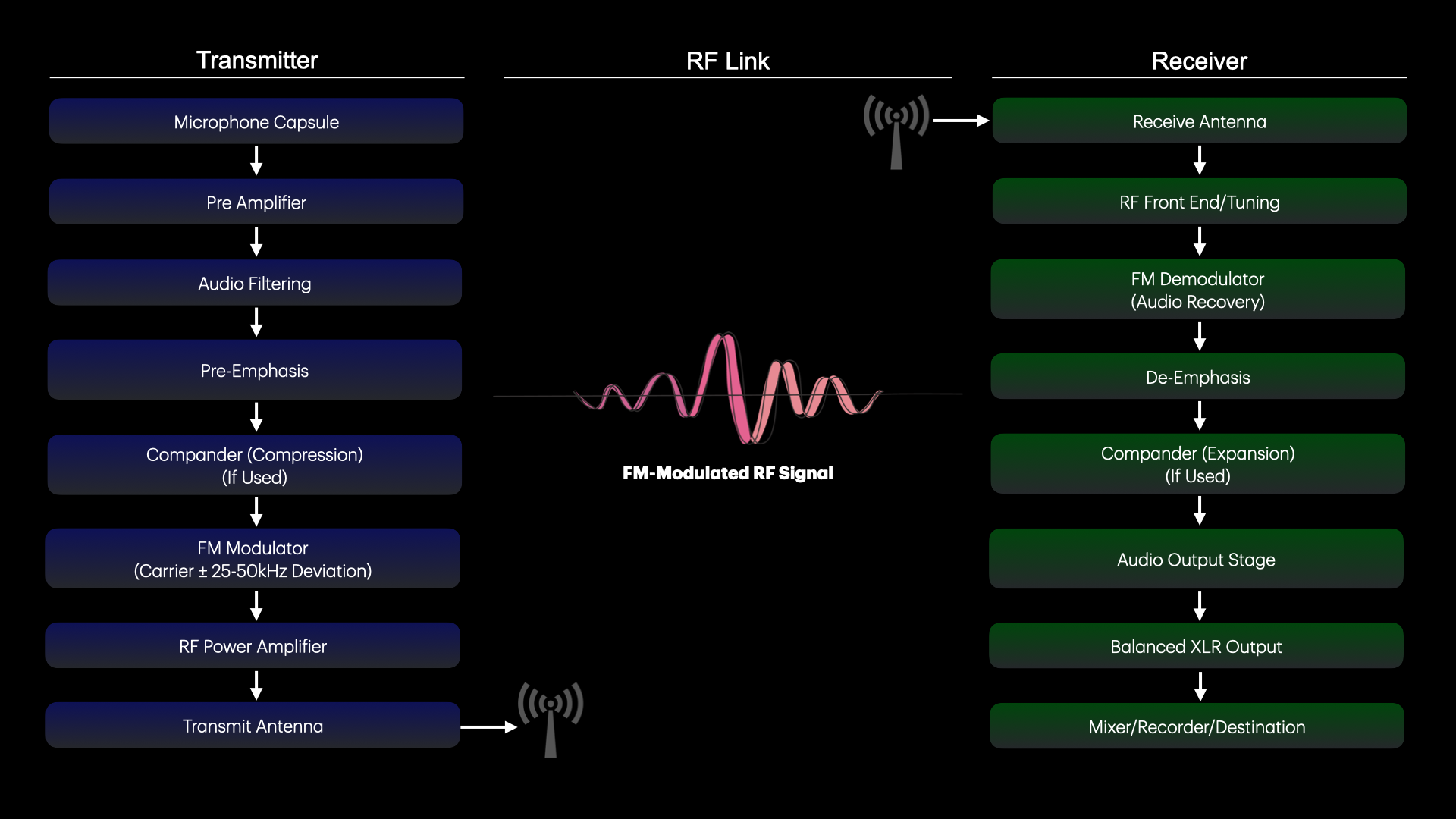
Analog wireless microphone system signal flow
Digital Wireless Microphone Systems
Digital wireless systems transmit audio by converting the analog signal into a digital bitstream, which is then modulated onto an RF carrier. Unlike analog FM, digital systems can deliver significantly wider dynamic range and flatter frequency response.
As with analog systems, the microphone signal is first converted to a low-voltage electrical signal, then pre-amplified and filtered. An analog-to-digital converter (ADC) samples the signal—commonly at 24-bit / 48 kHz, though some systems use 16-bit / 44.1 kHz—creating a digital representation of the audio waveform. Because digital transmission inherently supports wide dynamic range, analog companding is unnecessary, though some systems apply transparent digital processing or limiting for efficiency or headroom management.
The resulting bitstream is modulated onto an RF carrier using digital modulation schemes such as QPSK, π/4-DQPSK, 8PSK, 16QAM, or, in some designs, OFDM. Instead of continuously varying frequency, the carrier’s phase and/or amplitude changes in discrete steps to represent binary data. Channel bandwidth typically ranges from several hundred kilohertz to over one megahertz, depending on system architecture, often allowing higher channel density than wide-deviation analog FM.
The modulated signal is amplified and transmitted via the antenna. At the receiver, the RF signal is demodulated to recover the digital bitstream. Error detection and forward error correction (FEC) are commonly employed to identify and repair transmission errors caused by noise or interference.
A digital-to-analog converter (DAC) reconstructs the original audio signal, which is then output—often via balanced XLR—without the need for de-emphasis or expansion.
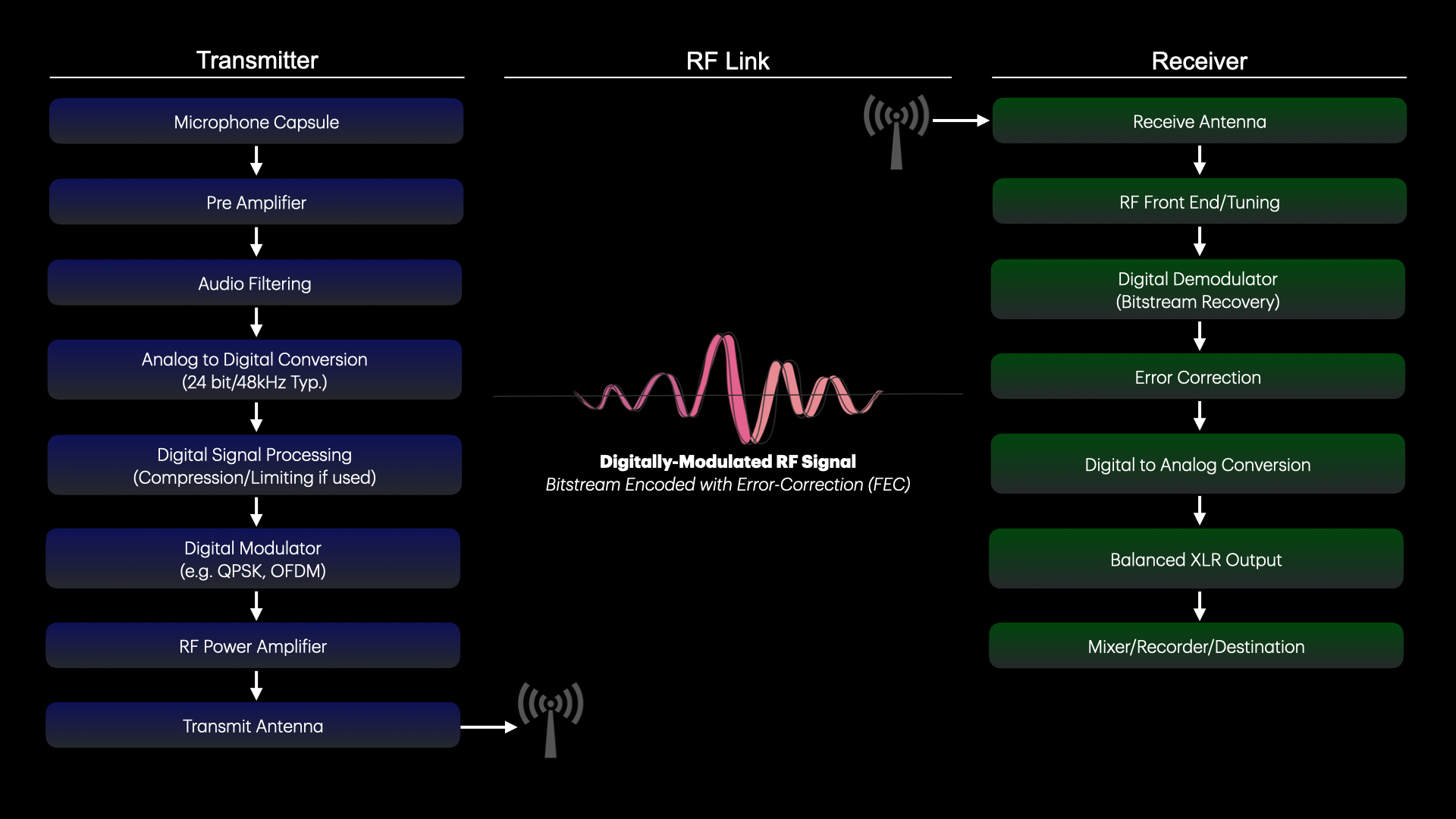
Digital wireless microphone system signal flow
Benefits
Analog Wireless Systems
Extremely low latency
Direct FM modulation and demodulation introduce negligible latency (typically under 1 ms), making analog systems ideal for live performance, in-ear monitoring, and other applications where immediate feedback is critical.Graceful degradation under weak RF conditions
As signal quality declines, analog systems tend to exhibit increasing noise or hiss rather than sudden dropouts, giving engineers audible warning before signal loss.Potentially longer usable range in certain designs
Higher RF output power and wider deviation in some analog systems can provide robust coverage, particularly in open or line-of-sight environments.Lower cost of entry
Analog systems remain widely available at accessible price points, offering reliable performance without the added cost of digital conversion and processing.Proven simplicity and reliability
Decades of refinement make analog systems straightforward to deploy and troubleshoot, with fewer layers of software or digital complexity.
Digital Wireless Systems
Superior audio fidelity and dynamic range
Digital systems routinely deliver dynamic range exceeding 110–120dB, with flat frequency response and no companding artifacts.Higher spectral efficiency
Digital modulation allows more channels to coexist within the same RF spectrum, a major advantage in congested or regulated environments.Improved resistance to noise and interference
RF noise does not gradually degrade audio quality; instead, the signal remains clean until error correction limits are exceeded.Enhanced security
Built-in encryption (such as AES-256) protects against eavesdropping—an essential feature for corporate, broadcast, and sensitive applications.Often improved battery efficiency
Modern digital designs frequently achieve longer transmitter runtimes through efficient processing and power management, depending on system architecture.
Analog vs Digital wireless
Drawbacks
Analog Wireless Systems
Higher noise floor and limited dynamic range
Companding can introduce audible artifacts such as pumping or “breathing,” particularly with wide-dynamic sources.Lower spectral efficiency
Wider deviation and channel spacing limit the number of simultaneous channels within a given frequency band.No inherent security
Analog transmissions are unencrypted and can be intercepted by compatible receivers.Greater susceptibility to RF interference
Noise and interference add directly to the audio signal, progressively degrading quality before dropout.Reduced innovation focus
While still widely used, many manufacturers are prioritising digital platforms for future development.
Digital Wireless Systems
Higher latency
ADC, processing, error correction, and DAC stages introduce additional delay. Although modern systems have significantly reduced latency, it can still be perceptible in some performance scenarios.The “digital cliff” effect
Audio remains pristine until the RF signal drops below a critical threshold, at which point dropouts or muting occur abruptly.Higher cost
Digital systems generally command higher prices, particularly for multi-channel or feature-rich configurations.Increased system complexity
Firmware, networking, clocking, and software control can lengthen setup time and complicate troubleshooting.Range dependent on system design
Some digital systems trade transmission power or bandwidth for spectral efficiency, which can reduce range in certain environments—though this is a design choice rather than a fundamental limitation of digital technology.
Parting Thoughts
Both analog and digital wireless systems remain valid, professional tools. The optimal choice depends on application, RF environment, latency tolerance, channel count, and budget. Understanding how each technology behaves—both sonically and spectrally—allows engineers and performers to deploy wireless systems with confidence and predictability.